You Acquired Their Expertise. Can Your Team Actually Find It?
How engineering and environmental firms can turn M&A's biggest blind spot into a day-one advantage
M&A among engineering and environmental firms is running at roughly 450 deals a year. Private equity is involved in about half. Environmental firms alone account for one in five transactions.
Deal teams know how to integrate systems, people, and operations. Most playbooks cover IT, HR, and facilities. But there's one asset that almost nobody has a plan for, and it might be the most valuable thing in the building.
What gets overlooked in AEC acquisitions?
When you acquire a firm, you're not just buying headcount and client relationships. You're buying years of solved problems. Proven report language, refined methodologies, deliverable structures built over decades. Thousands of geotechnical investigations, Phase I ESAs, property condition assessments, and remediation plans.
That expertise almost never lives in a usable system. It lives inside reports scattered across file shares, legacy systems, and local drives. It's not searchable. It's not connected to the acquiring firm's workflows. And the people who knew where to find the good stuff are often the first to leave after a deal closes.
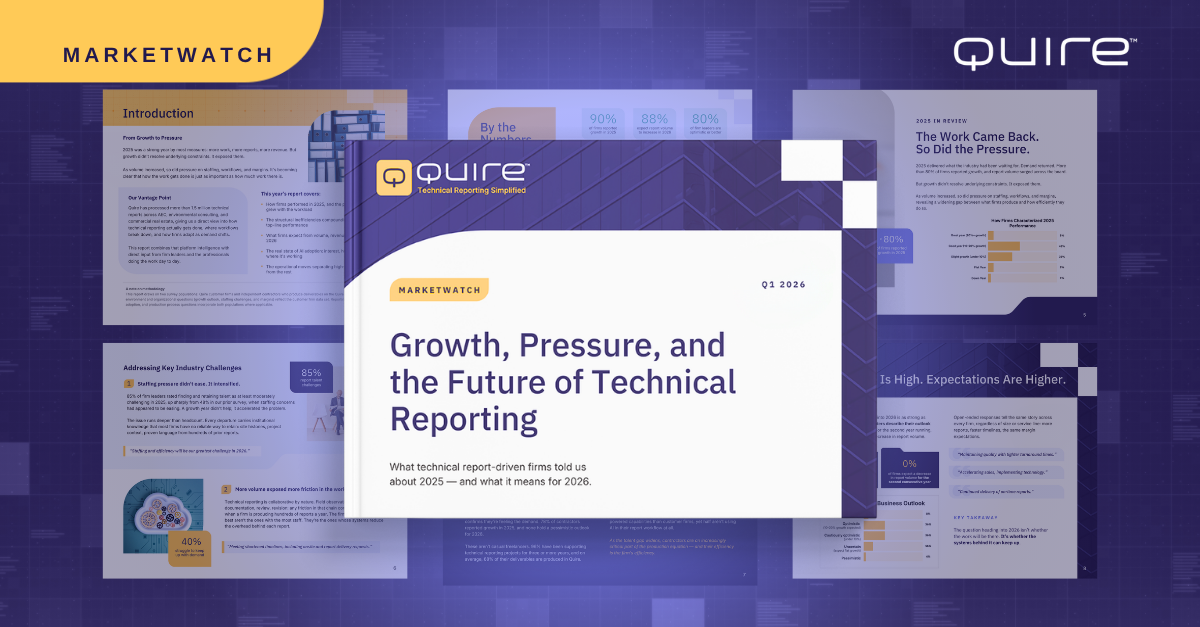
According to Quire's Q1 2026 MarketWatch Survey, 85% of firm leaders now rate finding and retaining talent as a significant challenge. Every departure carries institutional knowledge that most firms have no reliable way to retain. In an M&A context, that risk compounds. The acquiring firm paid a premium for expertise it can't locate or reuse. Teams recreate work that already exists somewhere in the combined organization. The synergies that justified the deal stay theoretical.
Why traditional knowledge transfer fails after acquisitions
Most post-merger integration plans treat knowledge transfer as a people problem. Assign mentors. Run transition meetings. Document what you can before the departures start.
The issue is that this approach doesn't scale. A firm with 20 years of report history can't transfer that knowledge through meetings. The volume is too large, the context is too specific, and the timeline is too short. By the time the integration team realizes how much institutional knowledge is at risk, the people who carried it have already moved on.
File migration doesn't solve it either. Dumping the acquired firm's shared drive into the acquiring firm's system just creates a bigger, messier archive. Nobody at the acquiring firm knows the folder structure, the naming conventions, or which reports are worth referencing. The knowledge exists. It's just inaccessible.
What would effective knowledge integration actually look like?
The combined firm needs something fundamentally different from a file dump into a shared drive. It needs a system that takes the acquired firm's entire report history and makes it usable alongside the acquiring firm's existing work. A way for any engineer to surface how similar problems were solved before, extract the language that worked, and build on each other's best thinking from day one.
Picture a geotechnical engineer asking: "Show me all reports where we encountered undocumented fill and recommended overexcavation." And getting grounded, cited results from both firms' archives in seconds. Or an environmental consultant asking: "How have we framed recognized environmental conditions when historical dry cleaning operations were present?" And finding the strongest language from either side of the house.
Not just document retrieval. A project precedent engine that compares approaches, surfaces decision logic, and turns scattered archives into unified intelligence.
How AI-powered knowledge engines solve the M&A integration problem
This is the problem Quire Lazarus was built to address. Lazarus is an AI-powered knowledge engine that transforms a firm's legacy technical reports into a living, conversational knowledge base inside the Quire platform. For firms in the middle of an acquisition, it functions as a purpose-built integration accelerator.
Watch the Demo: Lazarus AI-Powered Knowledge Engine
Rapid distillation of the acquired firm's report library. The acquired firm's reports come in every shape: different formats, naming conventions, folder structures. Lazarus ingests all of it through bulk migration, automatically converting, indexing, and organizing thousands of reports. In weeks, a chaotic archive becomes a structured, navigable library unified with the acquiring firm's existing work.
Precedent surfacing across both organizations. Once both libraries are in the system, the combined archive becomes conversational. Teams can ask questions across both organizations using natural language, surface precedents they didn't know existed, and pull findings into current work without tracking down a colleague they've never met.
Knowledge flowing in both directions. The acquired firm might have a sharper approach to comparing shallow versus deep foundation recommendations. The acquiring firm might produce the cleanest PCA reserve framing in the industry. Without a shared platform, those strengths stay siloed. With a unified knowledge engine, engineers discover better methodologies from the other firm's archive. Reviewers find tighter language from the other side of the house. The best thinking from both firms becomes available to everyone.
Consider this example: a geotech team searches for "uncontrolled fill." The system surfaces reports from both firms, identifies which required removal and which treated it as conditional, extracts the trigger language, and groups it into reusable scenario types. What started as a single query becomes standardized language the entire combined firm can use on the next project.
Evidence-based standardization. Post-merger standardization is typically slow, top-down, and rarely picks the best approach from either firm. A knowledge engine enables AI-powered parsing across the combined library to surface the strongest content from both organizations. The trigger language that reduced geotech review cycles. The REC framing that most clearly separated observed from inferred conditions. The report structures that earned first-pass approvals. That content becomes a unified "best of both" standard, built on evidence rather than opinion.
Compressed time to value. Bulk migration completes in weeks. The combined organization gets immediate, unified access to its entire deliverable history. The first 90 days after close set the tone for any integration, and when people in the acquired firm see their knowledge being valued and put to work immediately, it builds confidence in the deal.
Why this matters for serial acquirers
For firms that acquire regularly, a repeatable knowledge integration pathway changes the economics of every deal. Each acquisition adds to a growing, interconnected knowledge base. Better precedent leads to stronger reusable language and sharper templates, which make the next report better than the last. It compounds.
The second deal is faster than the first. The fifth is faster than the second. The combined knowledge base grows more valuable with every transaction. Competitors without a unified platform simply cannot replicate that advantage over time.
The firms that integrate knowledge will win
The consolidation wave in AEC isn't slowing down. The firms that come out ahead won't just close the most deals. They'll extract the most value from every acquisition. And the single biggest untapped source of that value is the technical expertise locked inside legacy reports.
Your next acquisition will bring you new offices, new clients, and new talent. The question is whether it also brings you their best work.
Ready to see what knowledge integration looks like in practice? Schedule a Lazarus demo.